
What Is a Stock? A Complete Beginner's Guide to Understanding Shares
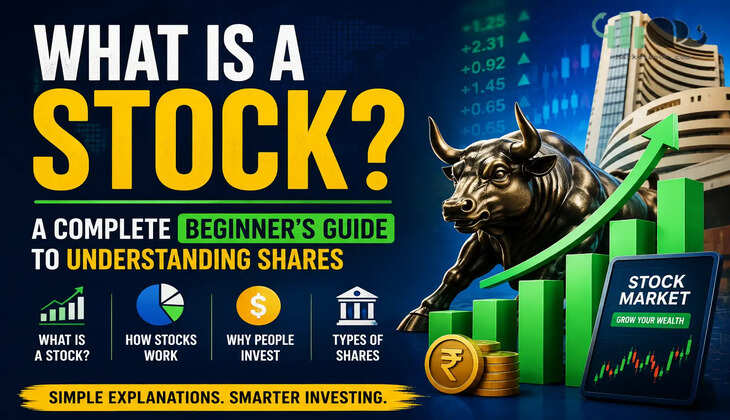
- A stock (or share) represents partial ownership in a company.
- Shareholders can earn returns through capital appreciation and dividends.
- Companies issue shares to raise capital for business growth without borrowing money.
- Shares are first sold in the primary market through an Initial Public Offering (IPO).
- After listing, shares are traded between investors on stock exchanges such as the NSE and BSE.
- Stock prices change based on supply and demand, company performance, economic conditions, government policies, and investor sentiment.
- Some companies pay dividends from their profits, while others reinvest earnings to fuel future growth.
- Stocks can be classified as common, preferred, growth, value, income, cyclical, or defensive, each with different characteristics.
- Market capitalization categorizes companies into large-cap, mid-cap, and small-cap based on their size.
- Large-cap stocks are generally more stable, while mid-cap and small-cap stocks offer higher growth potential with higher risk.
- Investing in stocks provides opportunities for long-term wealth creation but also involves the risk of losing money.
- Understanding how stocks work is the first step toward becoming a confident and informed investor.
If you have ever heard someone say "I own shares in Reliance" or "I bought stock in TCS," you have probably wondered what that actually means. Are they lending the company money? Do they get a say in how it is run? What happens if the company does well, or badly?
This article breaks down exactly what a stock is, how companies create and sell them, how prices move, and what the different types of stocks mean for you as an investor. By the end, you will understand the building block that every stock market investment is made of.
The Simple Definition
A stock, also called a share or equity, is a small unit of ownership in a company. When a company issues shares and you buy one, you are not lending the company money. You are buying a slice of the business itself
That ownership gives you two things:
-
A claim on the company's profits, which the company may distribute to you as a dividend.
-
A claim on the company's growth, which shows up as the share price rising (or falling) as the business becomes more (or less) valuable.
If a company has issued 1 crore shares and you own 100 of them, you own 0.0001 percent of that company. It sounds small, but multiply that ownership across a portfolio of companies and you have a real stake in the economy's growth.
Why Do Companies Issue Shares in the First Place
Every business needs capital to grow, whether that is to build factories, hire people, develop products, or expand into new markets. There are two broad ways to raise that capital:
-
Debt, where the company borrows money and must repay it with interest, regardless of how the business performs.
-
Equity, where the company sells ownership stakes to investors in exchange for capital, with no obligation to repay that money or guarantee any return.
Equity is attractive to companies because it does not create a repayment burden. In exchange, shareholders take on more risk than lenders. If a company fails, lenders and any preference shareholders are paid back before common shareholders see a rupee.
The Primary Market: Where Shares Are Born
When a private company decides to sell shares to the public for the first time, it does so through an Initial Public Offering, or IPO. This is called the primary market because the company itself is the one selling the shares and receiving the money.
India's IPO market has stayed active. In a single month, October 2025, ten mainboard IPOs together raised more than Rs 44,930 crore, led by heavyweight listings from Tata Capital and LG Electronics India, which alone accounted for over Rs 27,000 crore between them. This shows just how much fresh capital flows from ordinary investors into Indian businesses every year.
The Secondary Market: Where Shares Are Traded
Once a company lists, its shares move to the secondary market, which is what most people simply call "the stock market." Here, investors buy and sell shares among themselves. The company does not receive any additional money from these trades, but the secondary market is essential because it gives shares liquidity, meaning you can convert your investment back into cash whenever you want, at a price the market agrees on.
In India, this trading happens on two main exchanges:
-
The National Stock Exchange (NSE), whose benchmark index, the Nifty 50, tracks the 50 largest listed companies.
-
The Bombay Stock Exchange (BSE), Asia's oldest stock exchange, whose benchmark index, the Sensex, tracks 30 major companies.
Both exchanges are regulated by the Securities and Exchange Board of India (SEBI), and all trades are electronic. When you buy a share, it does not arrive as a paper certificate. It is credited straight into your Demat account, a digital locker for your securities, in much the same way money sits in your bank account.
How Stock Prices Actually Move
A share's price is simply the point where a buyer and a seller agree to trade at that moment. That price constantly shifts based on supply and demand, and demand itself is shaped by a mix of factors:
-
Company performance, such as quarterly profits, revenue growth, and management decisions.
-
Industry and economic trends, like interest rates, inflation, and sector specific news.
-
Government policy, including budgets, regulation, and taxation.
-
Global events, from oil prices to geopolitical developments.
-
Investor sentiment, which can push prices well above or below what the underlying business logically justifies, at least temporarily.
Here is the important nuance. In the short term, prices are driven heavily by sentiment and news flow, and can be genuinely unpredictable. Over the long term, however, share prices tend to track the growth in a company's actual earnings. A business that consistently grows its profits tends to see its share price rise over years and decades, even if it has rough months along the way.
Dividends: Getting Paid to Hold a Stock
Some companies share a portion of their profits directly with shareholders in the form of a dividend, usually paid out quarterly or annually. Others, especially younger or fast growing companies, choose to reinvest all their profits back into the business instead of paying dividends, on the theory that reinvested capital will grow the share price faster than a cash payout would.
Neither approach is automatically better. A mature, stable business like a large bank or an FMCG company might pay a steady dividend because it does not need every rupee of profit to keep growing. A fast expanding technology or manufacturing company might pay nothing at all because every rupee is going into new capacity. This is one reason total return indices, which assume dividends are reinvested, tend to show higher long term figures than plain price return indices, even when tracking the exact same companies.
The Main Types of Stocks
Not all shares are the same. Understanding these categories will help you make sense of financial news and fund fact sheets.
Common stock versus preferred stock. Common stock is what most people mean when they say "shares." It usually carries voting rights, letting shareholders vote on major company decisions, and gives a residual claim on profits and assets, meaning common shareholders are paid last, after all other obligations are settled. Preferred stock, less common in India but still relevant, generally guarantees a fixed dividend and priority over common shareholders if the company is liquidated, but usually comes with limited or no voting rights.
Growth stocks versus value stocks. A growth stock belongs to a company whose earnings are expected to expand faster than the broader market, often trading at a higher price relative to current profits because investors are paying for future potential. A value stock trades at a relatively low price compared to its earnings, assets, or peers, either because the market has genuinely undervalued it or because the business faces real problems the low price is warning you about.
Income stocks. These are shares bought mainly for a steady, reliable dividend rather than for rapid price appreciation, typically issued by mature, cash generating businesses.
Cyclical versus defensive stocks. Cyclical companies, such as automakers or real estate developers, see their profits rise and fall with the broader economy. Defensive companies, such as consumer staples or utilities, tend to see steadier demand regardless of economic conditions, since people keep buying necessities in good times and bad.
Market Capitalisation: Large Cap, Mid Cap, and Small Cap
Market capitalisation, or "market cap," is calculated by multiplying a company's current share price by its total number of outstanding shares. It measures what the market currently thinks the entire company is worth as a business, not its sales or the value of its physical assets.
For example, a company with 10 crore shares trading at Rs 200 each has a market capitalisation of Rs 2,000 crore.
SEBI has laid down an official classification that every mutual fund and index in India follows:
-
Large cap: the top 100 companies by market capitalisation. These tend to be the most stable, well established, and heavily traded names, sometimes called "blue chip" stocks.
-
Mid cap: companies ranked 101st to 250th by market capitalisation, generally valued in the range of roughly Rs 5,000 crore to Rs 20,000 crore. These businesses often grow faster than large caps but come with more volatility.
-
Small cap: companies ranked 251st and beyond. This category offers the highest growth potential in the market, along with the highest risk and the least liquidity.
This classification matters in practice. During the market correction that ran from late 2024 into early 2025, midcap and smallcap indices fell around 18 to 22 percent, roughly double the decline seen in the large cap heavy Nifty 50 and Sensex over the same period. Size is not just a label, it is a real indicator of how much a stock's price is likely to swing.
A Real World Example
Imagine a company called Bharat Foods Ltd decides to expand its manufacturing capacity and needs Rs 500 crore. Instead of borrowing that money from a bank, it lists on the NSE through an IPO, issuing 5 crore new shares at Rs 100 each.
If you buy 200 of those shares for Rs 20,000, you now own a tiny fraction of Bharat Foods Ltd. If the company grows its profits over the next few years and investors become willing to pay Rs 150 per share, your holding is now worth Rs 30,000, a 50 percent gain, purely from the share price rising. If the company also pays a dividend of Rs 5 per share that year, you receive an additional Rs 1,000 in cash, simply for holding the stock.
Of course, the reverse can also happen. If the expansion fails or profits fall short of expectations, the share price could drop below what you paid, and any dividend could be reduced or stopped altogether. This is the fundamental trade off of owning equity: unlimited upside potential, paired with real downside risk, and no guarantee of either outcome.